

Technical University of Moldova, as a CBHE project coordinator, is proud to announce a significant milestone demonstrating the tangible impact international cooperation projects can have on national education systems.
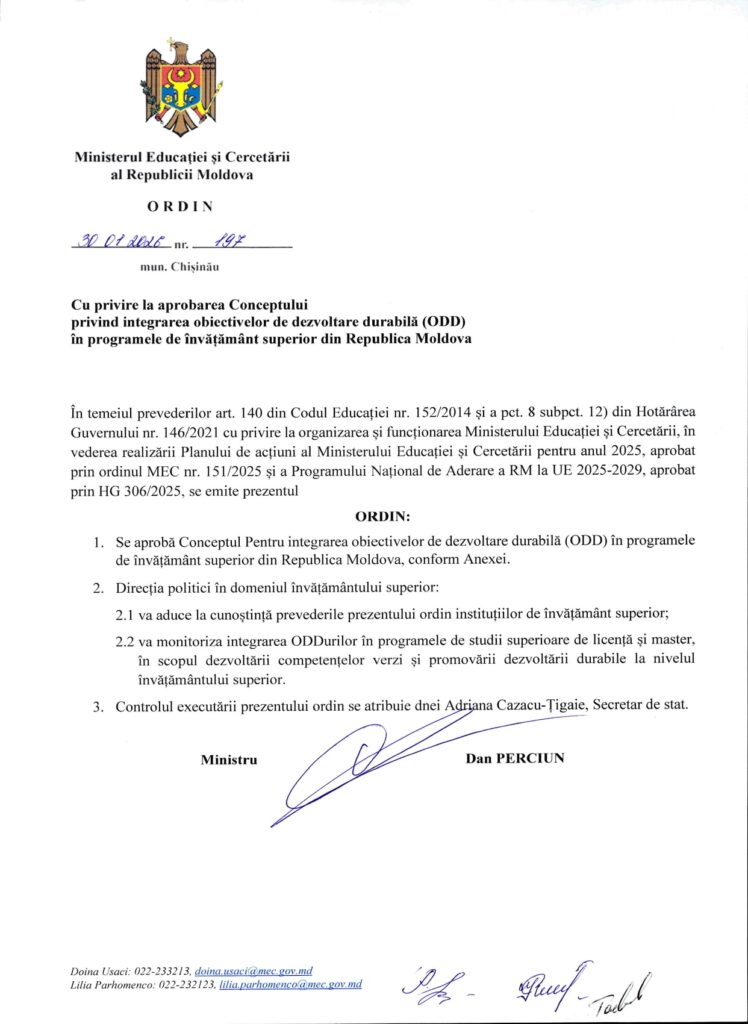
The Ministry of Education and Research of the Republic of Moldova has formally approved the Concept for the Integration of Sustainable Development Goals (SDGs) into Higher Education Programmes (Ministerial Order No. 197 of 30 January 2026), marking an important step in modernising higher education and aligning it with sustainability priorities. Developed within the Erasmus+ Capacity Building project RE-GRAD (Reforming Undergraduate Education for Green and Sustainable Development in Armenia and Moldova, ERASMUS-EDU-2023-CBHE-STRAND-3), the Concept establishes a national strategic framework enabling universities to embed sustainability competencies across undergraduate educational offers. Its adoption represents a concrete example of how international academic cooperation can translate into structural policy change and support the transition towards more future-oriented higher education systems. The framework provides guidance for curriculum innovation, interdisciplinary learning, and strengthened engagement with labour market stakeholders, contributing to improved graduate preparedness for green and digital transitions.
Despite growing policy attention to sustainable development in education the systematic integration of Education for Sustainable Development (ESD) in Moldovan higher education has remained fragmented, often dependent on individual institutional initiatives and externally funded projects. In this context, the Concept contributes to addressing an acknowledged coordination gap by offering a national reference framework to guide universities in curriculum modernisation processes.The approval of the Concept by the Ministry of Education and Research of Moldova reflects collaborative input from Moldovan universities, European higher education partners, and industry representatives, demonstrating the value of multi-stakeholder approaches in designing policy-relevant frameworks. Aligned with UNESCO’s “ESD for 2030” roadmap, the Concept enables:
- Transition from traditional curricula to future-oriented, green study programmes;
- Integration of SDGs into Bachelor’s and Master’s degree programmes;
- Implementation of priorities from Moldova’s National Education Strategy 2030;
- Strengthening of sustainability competencies among graduates.
The Concept also introduces practical measures for greening higher education, including:
- Dedicated sustainability courses across disciplines;
- Interdisciplinary and transdisciplinary learning approaches;
- Student involvement in sustainability projects and research;
- Sustainable campus operations and infrastructure;
- Strengthened partnerships with industry, NGOs, and public institutions.
Beyond the project deliverables, the Ministry further acted on insights identified during RE-GRAD implementation, addressing critical national needs: Modernization of the Framework Plan for Higher Education, approved by Ministerial Order No. 510 of 07 April 2025, through the inclusion, in mandatory Component G, of courses on ecology and environmental protection in university curricula and specialized modules. This demonstrates the Concept’s added value beyond the original project scope, turning international collaboration into a concrete national policy instrument.
Parallel structural reform achievements within the project, such as the development of Sectoral Qualification Frameworks in Armenia, further illustrate the regional impact of Erasmus+ cooperation in supporting systemic modernisation aligned with European Higher Education Area standards.Together, these outputs contribute to a future-oriented, green, and sustainable higher education system in both countries.
Congratulations to all RE-GRAD partners and contributors whose dedication made this milestone possible. With initiatives like this, Moldova takes a decisive step toward preparing students for a sustainable future, embedding environmental, social, and economic responsibility into higher education.
Further information: